Legal Leaders Magazine: Issue 8 out now!
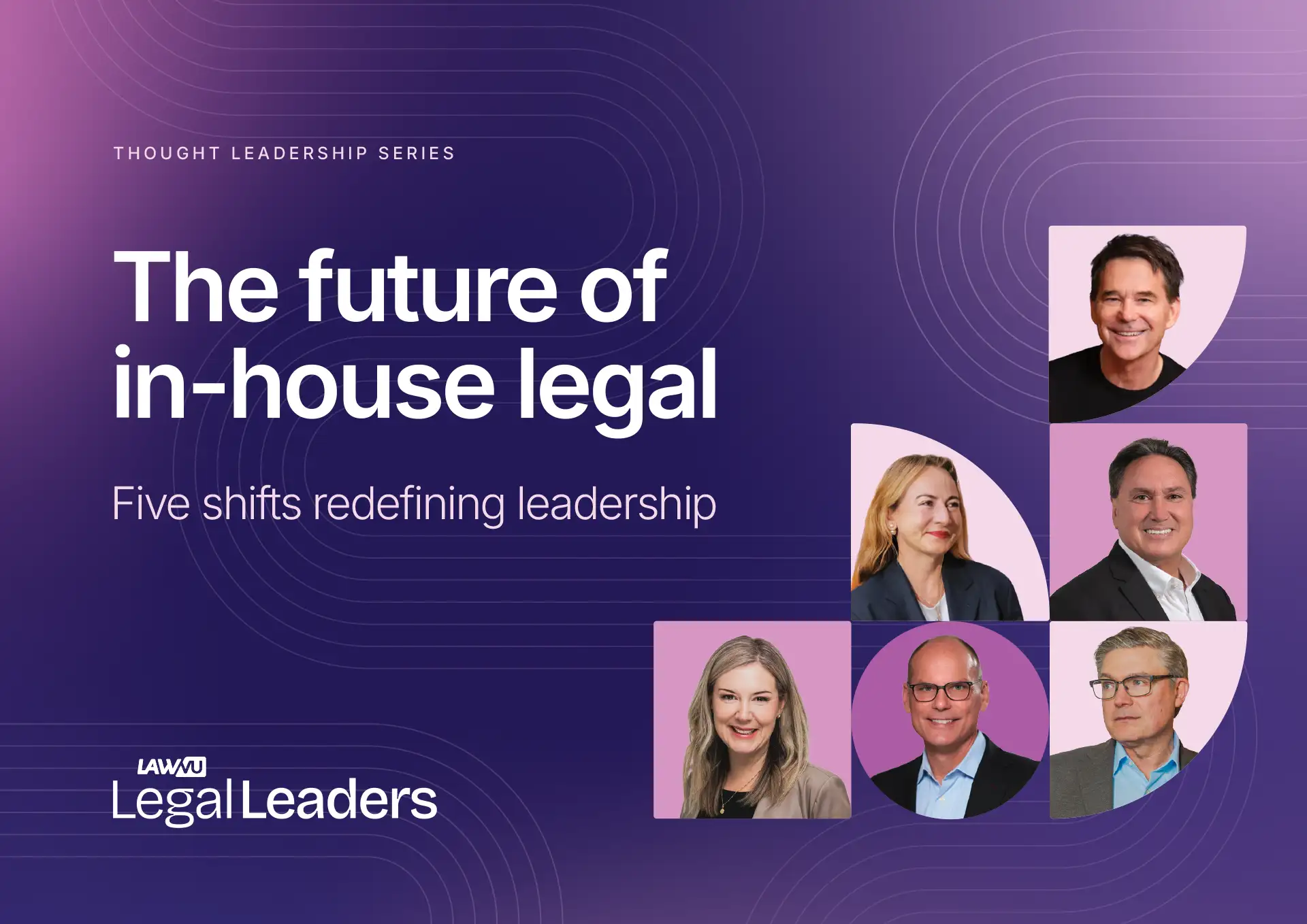
Thought leadership series

The future of in‑house legal

Five shifts redefining leadership
What Leaders Need Now

The future of in-house legal is not being shaped by a single trend. It is being driven by a convergence of forces that are fundamentally changing how organizations operate – and, in turn, what they require from legal.

Risk is becoming more interconnected and harder to isolate.

Businesses are moving faster and scaling more dynamically. Artificial intelligence is reshaping how work gets done and how decisions are made.

Legal continue to expand – often without a corresponding increase in resources.

Inefficient legal processes are no longer just operational challenges – they are measurable business constraints.

Individually, these shifts are significant. Together, they are redefining the role of in‑house legal.


Research shows

%

of revenue is delayed or lost due to legal inefficiency

%

of business leaders saying it directly impacts business outcomes

Across conversations with leading general counsel and legal executives, a consistent theme emerges: the future of legal is not about incremental improvement.

It is about repositioning the function within the enterprise – from a reactive advisor to an embedded, operational partner that helps the business navigate complexity, move faster, and deliver outcomes.

This shift is reinforced by global legal leaders such as Bill Deckelman, who has emphasized the expanding role of legal in governance, enterprise strategy, and long-term value creation.

This series brings together five distinct perspectives on that transformation.

Bjarne Tellmann - CEO at FjordStream Advisors, former GC Haleon & Pearson
What legal leaders should do now

While the direction is increasingly clear, the challenge is in execution.

Legal teams are being asked to do more, faster – but often without the operating model to support it. Today, 83% of legal teams say administrative work prevents them from focusing on strategic priorities (IDC Report, 2025).

01
Expanding legal’s role from risk management to decision enablement and enterprise judgment
02
Designing operating systems that combine technology, operations, and embedded expertise
03
Building multidisciplinary teams that extend beyond traditional legal roles
04
Measuring performance through business outcomes – not just activity
05
Developing leadership capability in execution, change management, and operational design
These are not isolated initiatives. They are interconnected responses to a broader shift in how legal creates value.
The shifts

The five shifts shaping the future of in‑house legal

Across industries, legal leaders consistently point to a set of structural changes reshaping how legal departments operate and how general counsel lead. Understanding both the shifts – and how different leaders interpret them – is critical.

01
Bjarne Tellmann - CEO at FjordStream Advisors, former GC Haleon & Pearson
with
Bjarne Tellmann
CEO, FjordStream Advisors

From isolated risk to systemic complexity

Legal risk can no longer be understood in isolation.

It now sits at the intersection of legal, technological, geopolitical, and economic forces. Decisions in one area increasingly create consequences in others, often in ways that are difficult to predict.

Bjarne Tellmann describes this as a fundamental shift in how legal must operate – from analyzing discrete issues to interpreting complex systems. Drawing on the concept of dragonfly thinking, he argues that modern general counsel must be able to see across multiple dimensions at once, understanding how different forms of risk interact and evolve.

This shift expands legal’s role. It is no longer just about identifying risk. It is about helping the organization make sense of it.

02
with
Lisa Mather
Head of Legal, Risk & Compliance, Fetch

From legal latency to speed as a requirement

The pace of business has changed.

Organizations now operate on compressed timelines, making decisions quickly and often with incomplete information. In that environment, traditional models of legal delivery – built for precision and completeness – can create friction.

The consequences are already visible across the business. 34% of business leaders report major project delays because of legal friction, with initiatives across sales, marketing, and product slowed or stalled entirely (IDC Report, 2025).

Lisa Mather frames this challenge in terms of legal latency – the gap between how fast the business moves and how quickly legal can respond.

Closing that gap requires more than working faster. It requires rethinking how legal delivers value – moving toward platform-based models that enable the business to operate at speed, supported by self-service tools, automation, and embedded legal expertise.

In this model, legal is not a checkpoint. It is an infrastructure.

03
with
Mark Smolik
CLO, DHL Supply Chain Americas

From position to influence – and trust as the differentiator

Legal’s shift toward strategic partnership is widely discussed.

But being positioned as a partner does not guarantee influence. Mark Smolik emphasizes that the defining factor is trust.

In fact, only 21% of business leaders say their legal function is highly effective in supporting business objectives, underscoring the gap between presence and true influence (IDC Report, 2025).

Legal teams that are deeply embedded in decision-making are not there by default. They are there because the business trusts their judgment, values their input, and sees them as contributors to outcomes – not obstacles to progress.

That trust is built through responsiveness, commercial understanding, and a consistent ability to help the business move forward.

Without it, legal remains present. But not influential.

This emphasis on trust and influence is echoed by leaders like Bill Deckelman, who has highlighted that legal’s role within the executive team is increasingly defined by its ability to contribute to enterprise decision-making, not just legal outcomes.

04
with
Paula Pépin
CEO & Founder, GC Collective / LexGo

From strategy to execution – the rise of the operator GC

There is broad alignment on how legal needs to evolve.

More strategic. More scalable. More integrated.

But many teams struggle to translate that vision into reality.

One reason is structural. Only 37% of legal teams believe they have adequate resources to meet demand, making execution a systemic challenge – not just a leadership one (IDC Report, 2025).

Paula Pépin argues that the defining capability for legal leaders is now execution. The role of the general counsel is expanding beyond strategy into operations – designing systems, implementing change, and ensuring that transformation happens.

This includes:

  • Building scalable processes
  • Implementing technology effectively
  • Driving adoption across teams
  • Managing change over time

The future of in-house legal will not be determined by ideas alone. It will be determined by the ability to execute them.

05
with
Sterling Miller
COO, General Counsel, & Senior Counsel, Hilgers Graben PLLC

From cost center to growth engine

For much of its history, legal has been defined by what it prevents. Risk avoided. Issues mitigated. Problems contained. That framing is no longer sufficient.

Today, inefficiency is not just a cost issue – it is a missed opportunity to create value. Inefficient legal processes cost organizations an average of 11% in delayed or lost revenue annually – roughly $141 million per organization. Two-thirds of business leaders agree: legal friction doesn't just slow the legal team down, it slows the entire business down (IDC Report, 2025).

Sterling Miller highlights a shift toward outcome-based value – where legal is measured by how it contributes to business performance. This includes enabling faster decisions, accelerating deals, and reducing friction across the organization.

Concepts like "time to yes" capture this shift. Legal is no longer evaluated solely on activity. It is evaluated on impact.

In this model, legal is not just protecting the business. It is helping it win.

06
with
Bill Deckelman
Chief Legal Officer, Andersen

From function to intelligence

The next shift is structural.

For Bill Deckelman, the future of in-house legal is not about working faster – it is about becoming an intelligence-driven function that shapes decisions, not just supporting them.

AI and data are enabling legal to move upstream – anticipating risk, surfacing insight, and guiding the business in real time.

The future will not be defined by how quickly lawyers respond, but by how effectively legal teams anticipate risk, generate intelligence, and shape business outcomes.

In this model, legal is no longer a service function. It becomes a system that helps the business see, decide, and act.

How It All Connects

How these shifts connect

Each perspective reflects a different dimension of the same transformation.

Individually, they are powerful. Together, they form a more complete picture of where legal is heading.

Leaders such as Bill Deckelman further reinforce this direction, highlighting the growing expectation for legal to operate as an integrated partner in governance, strategy, and enterprise performance.

Tellmann

defines the complexity legal must interpret

Mather

shows how legal must deliver at speed and scale

Smolik

explains what creates influence within the business

Pepin

focuses on how transformation is executed in practice

Miller

reframes how legal measures and demonstrates value

Deckelman

defines how legal evolves into an intelligence-driven function
Explore the full series

Six perspectives. One thought leadership series.

This article is part of the Future of In-House Legal series, which brings together perspectives from leading legal executives on how the role of legal is evolving across the enterprise.

Each article explores a different dimension of this transformation – from systemic risk and operating models to influence, execution, and value creation. Together, these perspectives provide a more complete view of how in-house legal is being redefined.

Get the complete Future of In‑House Legal series.

Download the full collection to access all perspectives in one cohesive report.

Researched, interviewed, and written by Michaelle Noble.

©2025 LawVu Limited, All Rights Reserved