
Sarah Webb
COO
at LawVu
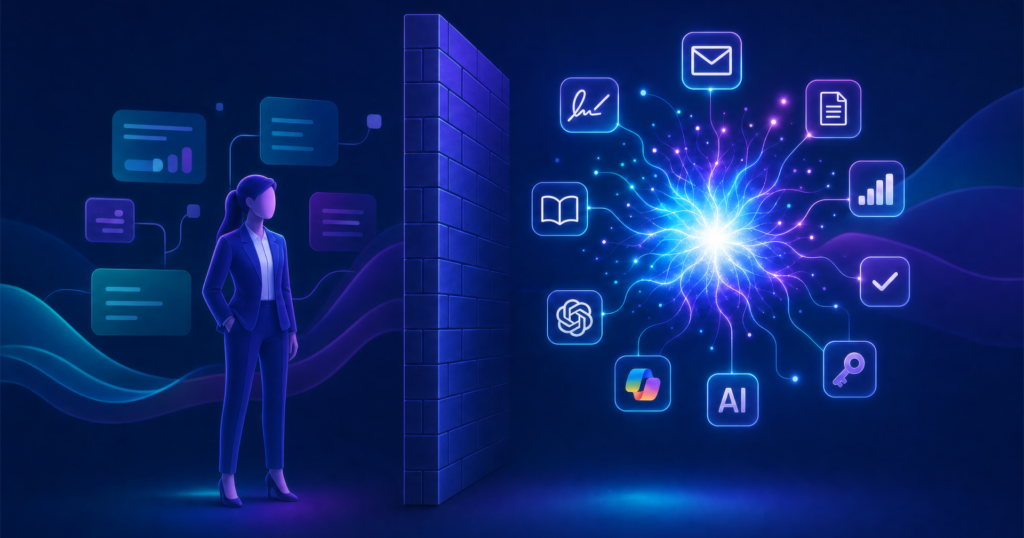

Horizontal AI is a brilliant stranger: it has read an extraordinary amount, writes beautifully, and has never met your client or sat in your negotiations. Connecting it to your playbook helps, but the most valuable legal knowledge sits in the exceptions. The question isn’t AI versus no AI, it’s how much of your organization’s own experience you’ve preserved for AI to learn from.
Every week I talk to legal teams who are already using ChatGPT, Copilot or Claude for real work, whether they’re approved or not. They’re summarising contracts before meetings, drafting emails, reviewing clauses and using AI as a sounding board when they need a second opinion.
None of that surprises me, because the technology is genuinely useful. It’s fast, accessible and i for many of the tasks that fill a lawyer’s day, it does a remarkably good job. And the legal teams seeing value from these tools are the ones taking advantage of them.
But what interests me more is where the value starts to taper off.
I’ve come to think about horizontal AI as a brilliant stranger, someone who has read an extraordinary amount, writes beautifully, and can hold a conversation about almost anything. But they’ve never met your client. They’ve never sat in your negotiations. They don’t know how your organisation balances risk. They’ve never seen the conversations that led to the exceptions your team agreed six months ago.
In many situations, that doesn’t matter, if you need a first pass at a contract summary, help structuring an argument, or a quick explanation of a legal concept, a brilliant stranger can be extremely helpful. In fact, they may be faster and better informed than most people in the room.
The limitation only starts to emerge when the question shifts from general legal knowledge to organisational judgement.
This is because legal teams rarely operate purely on legal principles hey operate within the reality of a particular business, a particular risk appetite, and a particular history of decisions. And that’s where legal knowledge becomes something more than information.
That’s why one of the first things many legal teams do is connect AI to a playbook. And to be clear, that’s incredibly valuable.
Give an AI model access to your preferred clauses, fallback positions, approval thresholds and negotiation guidance, and the efficiency gains appear almost immediately. Reviews become faster, responses become more consistent, and lawyers spend less time searching for guidance and more time applying it.
Most teams would see a measurable improvement from that alone. But I’ve observed that many organisations stop there.
The assumption is that once the AI knows the playbook, it knows how the legal team operates. Although the playbook is usually only part of the story.
Playbooks are designed to capture what should happen most of the time, they’re an attempt to codify consistency. And while I believe that every legal function should have them the challenge is that the most important legal decisions often happen when the standard position no longer fits. For example:
That’s where legal judgement starts to become visible. And that’s why I believe that some of the most valuable knowledge is stored in the exceptions, and not the playbook.
The answers rarely live in a single document, they’re scattered across contracts, approvals, emails, matter records, meeting notes and the accumulated experience of the people who were involved at the time.
The document simply records the outcome, and the organisation carries the reasoning elsewhere.
This is why I think many conversations about AI become overly focused on intelligence.
While AI can explain a limitation-of-liability clause and playbook-enabled AI can suggest your preferred position, neither necessarily understand why your organisation departed from that position the last three times a similar issue arose. The technology simply does what it can with the information available to it.
And that’s why I say that a brilliant stranger can learn the rules remarkably quickly, but understanding why the rules were bent in the first place is a different challenge altogether.
It’s also why I think we should stop framing the conversation as AI versus no AI.
Most legal teams have already moved beyond that debate. The tools are being used, whether organisations acknowledge it or not. The more relevant consideration is how organisations govern AI and what information they allow it to work with.
I’ve watched enough organisations try to ban AI outright to know how that usually ends. When approved tools fail to meet people’s needs, people find alternatives. Shadow AI is rarely a technology problem. More often, it’s a signal that the approved approach isn’t keeping pace with how people work.
The goal shouldn’t be to prevent lawyers from working with a brilliant stranger, it should be to ensure that stranger has enough organisational knowledge to provide consistent, trustworthy and explainable support. Because what usually separates useful AI from transformative AI is how much of its own experience the organisation has preserved for AI to learn from.
The moment AI can move beyond the rulebook and begin understanding the history behind the decisions, the conversation starts to change.
And that’s where the next wave of innovation is likely to be found.
This is the second of six articles on what it takes to get a legal team ready for AI. To read article one, Build vs. Buy was never a technology question, click here.