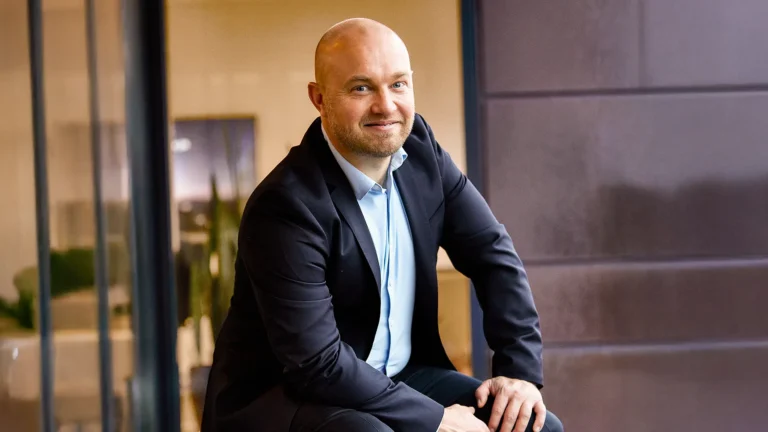
Redefining the modern GC: Inside Katja Fenton’s leadership at Fugro



The role of the General Counsel is changing fast – and nowhere is that shift more visible than inside global, technology-driven businesses operating at scale. Once defined primarily by risk mitigation and technical legal expertise, today’s in-house legal leaders are expected to operate as strategic executives: globally minded, commercially fluent, culturally agile, and deeply embedded in business transformation.
Few leaders illustrate this evolution as clearly as Katja Fenton, General Counsel at Fugro, and a recent guest on LawVu’s Legal Leaders Podcast, produced for Legal Leaders, LawVu’s global in-house legal community. In her conversation with host David Lancelot, LawVu’s Chief Legal Officer and EVP Advocacy, Fenton reflects on a career that spans continents, industries, and leadership models – and on why the modern GC must think far beyond traditional legal boundaries.
From advising on Olympic infrastructure in London to leading legal teams across the Middle East, Southeast Asia, and Europe, and now steering legal strategy for a highly technical, geopolitically exposed global business, Fenton’s journey offers a roadmap for aspiring in-house leaders. More importantly, her philosophy underscores a broader shift: the GC as a business enabler, not a gatekeeper; a strategic partner, not a reactive advisor.
Leading legal in a global, high-tech organization
Fugro is not a conventional business, which is precisely why it demands a future-ready legal function. Headquartered in the Netherlands and operating in more than 50 countries, Fugro is a global leader in geo-data, supporting safe and sustainable development of critical infrastructure across land, sea, and subsurface environments.
As Fenton explains, “Our expertise spans the full spectrum of the earth’s surface, from the ocean floor to mountainous terrain. We collect and analyze data so that we can help our clients design, develop, and build infrastructure – all with the mission to support a safer and more liveable world.”
This global footprint brings legal complexity at scale. Fugro operates a fleet of 35 highly specialized vessels, many of them at the forefront of innovation, and is increasingly investing in unmanned and remotely operated ships – a shift that is actively reshaping regulatory assumptions and legal risk models.
“Understanding how legislation is drafted, particularly in the area of vessels, is really important,” Fenton notes. “Sometimes you just can’t apply existing rules to unmanned vessels. Even basic health and safety requirements assume there’s a crew onboard.”
For in-house legal leaders, this underscores a critical lesson: legal expertise alone is no longer sufficient. Modern GCs must understand technology, geopolitics, data governance, and regulatory intent, often before rules are fully formed. At Fugro, that means legal works hand-in-hand with compliance, public affairs, and operational teams to anticipate regulatory change and influence outcomes where possible.
“All of these novel components require a different skill set,” Fenton says. “And that’s something you have to build deliberately into your legal and compliance teams.”
From risk manager to strategic business partner
One of the main themes running through Fenton’s leadership philosophy is the repositioning of legal as a strategic business function. When she joined Fugro as General Counsel in April 2025, she stepped directly into the executive leadership team – a clear signal of how the organization views legal’s role.
“The job description was not the traditional risk mitigation and compliance role,” she explains. “It really emphasized strategic business partnership. You’re expected to contribute to strategy, value creation, and company priorities while still ensuring we operate safely.”
Fenton summarizes her approach masterfully: “We’re absolutely not the department of no. We’re the department of yes – and let’s do that in the safest way we can.”
This mindset reflects a broader shift discussed on the podcast: legal leadership today mirrors where finance was a decade ago – moving from back-office support to core strategic influence. For Fenton, the GC’s credibility now rests as much on influence, collaboration, and cultural leadership as it does on legal analysis.
“Your legal expertise is almost a given,” Fenton says. “What differentiates you is everything else you bring to the role.”
Building a high-performing global legal team
At Fugro, legal capability is embedded across the business. Fenton leads lawyers in around 12 locations globally, representing more than 30 nationalities – a structure that reflects both scale and intent. That diversity is not incidental, it is essential.
“Different cultures and perspectives aren’t a bonus; they’re a requirement. You need a global vision, but you also need people who can translate that locally and who feel comfortable speaking up,” she says.
For aspiring legal leaders, this highlights a crucial capability: cultural agility as a core leadership skill. Global policies fail when they ignore local realities. Effective GCs understand that leadership by influence, not hierarchy, is what enables legal teams to operate at speed and scale.
Fenton emphasises that modern legal teams must help the business accelerate, not slow down. “You can’t do that if you’re working in a traditional in-house mindset,” she says. “Legal needs to be part of the conversation from the start.”
An international career built by saying yes
Fenton’s ability to lead through complexity did not emerge overnight. It was shaped by a series of deliberate and sometimes uncomfortable career choices.
Raised in London to a Dutch mother and British father, she developed an early interest in languages and international work. While training as a lawyer in London, she deliberately sought exposure beyond the UK. “I was quite deliberate about where I applied, because I knew early on that I wanted an international component to my career,” she says.
A formative moment came during her secondment to the Olympics Delivery Authority ahead of the London 2012 Games. “Every day I was in meetings where there wasn’t necessarily a legal issue – but legal needed to be there,” she recalls. “That was when I realized I didn’t want to be at the end of the line drafting documents. I wanted to be part of shaping outcomes from the beginning.”
From there, Fenton’s career became increasingly global: three years in Dubai and Abu Dhabi with Clifford Chance, followed by a move in-house in the Middle East, then a leap to Bangkok to lead legal and compliance across Southeast Asia for BlueScope Buildings.
“When I moved to Thailand, I didn’t expect to find a role at all,” she admits. “But sometimes opportunities appear when you least expect them – if you’re willing to say yes.”
Working outside headquarters roles taught her another vital lesson: global leadership fails without local voice. “If you roll out global programmes without accounting for local realities, they fall flat,” she says. “You need teams who feel safe to speak up, and that doesn’t come automatically.”
The power of allies and networks
Perhaps the most powerful insight from Fenton’s story is the role of relationships in shaping leadership trajectories. “One of the biggest things I’ve learned is the importance of allies – people who are willing to say your name in rooms you’re not in.”
Throughout her career, mentors and sponsors opened doors. From senior GCs who backed her transition in-house to leaders who took a chance on her “non-traditional” CV. Today, Fenton sees it as part of her responsibility to do the same for others.
“Now I look around for quiet talent, and I ask how I can support them,” she says. “You can’t always create opportunities yourself, but relationships can.”
Her advice to aspiring legal leaders is both simple and profound: “Say yes a lot. And nurture those relationships. They really do open doors.”
Lessons for in-house legal leaders
Fenton’s career does not follow a neat or traditional path – and that is precisely the point. Her journey reflects the reality of modern legal leadership: nonlinear, global, shaped by opportunity as much as planning, and defined by mindset rather than title. For current and aspiring in-house legal leaders, her story offers several enduring lessons.
- Legal expertise is the baseline – leadership is the differentiator
One of Fenton’s most striking observations is that legal capability is assumed at senior levels. It is no longer what distinguishes a General Counsel. “Your expertise is almost a given,” she explains. “Then it’s all the other parts that you bring to it that really matter.”
Those “other parts” increasingly include strategic judgment, commercial awareness, communication, and the ability to influence without authority. Modern GCs are expected to engage in discussions about growth, innovation, and transformation – not simply assess risk after decisions are made.
For aspiring leaders, this means developing skills beyond black-letter law early: understanding how the business makes money, how decisions are shaped, and how legal insight can accelerate outcomes rather than constrain them.
- Move closer to the business as early as possible
A defining theme in Fenton’s career is proximity. From her secondment to the Olympics Delivery Authority to her in-house roles across regions, she consistently sought opportunities to be embedded in decision-making.
“I realized I didn’t want to be at the end of the line,” she says. “I wanted to be there from the beginning, shaping outcomes, not just documenting them.”
This lesson is particularly relevant for lawyers early in their careers. The more time legal professionals spend alongside commercial, operational, and technical teams, the faster they develop the instincts required of senior leaders. Being present in conversations where there is no immediate legal issue is often where the greatest value, and learning, lies.
- Global mindset is built through experience, not theory
Fenton’s leadership style has been shaped by lived experience across Europe, the Middle East, and Southeast Asia. Each move exposed her to different ways of working, communicating, and leading, often through trial and error.
“When you’re working across cultures, miscommunication can have a huge impact,” she reflects. “I learned that firsthand.”
For modern GCs operating in global organizations, cultural agility is no longer optional. Leading international teams, rolling out global frameworks, and advising on cross-border risk all require sensitivity to local realities. Fenton’s experience underscores that the most effective legal leaders listen deeply, adapt thoughtfully, and resist one-size-fits-all solutions.
- Growth often feels like discomfort – learn to lean into it
Several pivotal moments in Fenton’s career involved stepping into roles where she initially felt out of her depth: managing compliance for the first time, leading teams across unfamiliar jurisdictions, or working far from headquarters.
“When I get that out-of-my-depth feeling, I’ve learned to enjoy it because it usually means there’s an opportunity to learn.”
This mindset is critical for legal leaders navigating transformation – whether that means new technologies, evolving regulations, or expanded leadership expectations. Rather than seeing uncertainty as a risk, Fenton reframes it as a signal for growth.
- The GC as an enabler of innovation, not a brake
At Fugro, legal operates at the frontier of technological and regulatory change, from unmanned vessels to remote operations and geopolitical risk. This environment demands a legal function that enables innovation safely, rather than defaulting to conservatism.
“We’re not the department of no,” Fenton says. “We’re the department of yes, done safely.”
For modern GCs, this philosophy is foundational. Legal teams that are perceived as blockers quickly lose influence. Those that help the business move faster, with guardrails rather than roadblocks, earn trust and strategic relevance.
- Networks and allies matter more than you think
Perhaps the most personal and powerful lesson from Fenton’s journey is the role of relationships. At several points, her career progressed because someone else advocated for her when she was not in the room.
“It’s about the people who are willing to say your name in a room you’re not in,” she explains.
She encourages aspiring leaders to both seek allies and be one. Saying yes to opportunities, nurturing relationships, and staying curious about others’ work can open doors that technical excellence alone cannot. Now, as a General Counsel, she sees supporting emerging talent as part of her responsibility.
“You can’t always create opportunities yourself,” she says. “But relationships can.”
- The future GC is a leader first, lawyer second
Taken together, Fenton’s insights paint a clear picture of the modern GC: globally minded, strategically engaged, culturally fluent, and comfortable with ambiguity. Legal excellence remains essential, but leadership is what elevates the role.
For in-house lawyers aspiring to follow a similarly global and impactful path, Fenton’s advice is refreshingly human: stay curious, say yes more than no, build relationships, and don’t wait to be invited into the conversation.
Listen to Fenton’s full conversation with David Lancelot and explore more insights from modern legal leaders worldwide on the Legal Leaders Podcast, part of the Legal Leaders community.