AI is getting more powerful by the week. For legal, I don’t think the model alone is going to be the thing that matters most. What matters is what sits underneath it, the data it can access, the context it understands, the actions it can take and the guardrails it operates within. After 12 years building LawVu, that’s the part I’m more excited about than ever.
Legal is having a moment, and I don’t think any of us saw it coming as fast. Legal tech ads are turning up on city streets, celebrities are endorsing it, and sports teams are wearing legal tech branding. A function that spent decades out of sight, quietly doing the critical work nobody else noticed, is suddenly one of the most talked about corners of the AI economy. And if legal is having a moment, I think in-house legal is about to become one of the biggest forces for change inside businesses.
It feels like every day there’s a new AI legal startup appearing on LinkedIn, usually followed by someone announcing the end of lawyers. I have a personal stake in that not being true. My son Ryan starts law school next year, and I’d rather he wasn’t living with me until he’s 40, so I’m counting on all of us to make sure that prediction never plays out.
Joking aside, I don’t see lawyers going away. What I see however is a complete rebuild of the way legal work gets done. The next era of in-house legal belongs to teams whose AI runs on a governed legal operating system, and that era has already started.
From incinerators to custodians
When I co-founded LawVu, in-house teams were doing an enormous amount of critical work with almost no visibility of it. There was no real data. Knowledge lived in inboxes, in documents, and in folders scattered across the business. I used to joke that legal teams were some of the largest collectors of data in any organization, and equally the largest incinerators.
From day one our philosophy was to meet people where they are. That’s why we started with integrations into Outlook and Word, the tools lawyers already live in. We made a second decision early on, which was to be open. We were never going to be the company that holds your data hostage and charges a fortune if you want to leave. (Not that you’ll ever want to.)
“Legal teams were some of the largest collectors of data in any organization, and equally the largest incinerators.”
We believed that if you get those foundations right, anything that comes next becomes possible. As we added structure and connected data across intake, matters, contracts, spend, and documents, legal teams stopped incinerating their data and finally became its custodians.
The arrival of AI
Even for us, AI blew up our roadmap. We’d always been building for an AI future, but the speed it landed at was astounding. Like everyone else, we started with the basics: asking questions of your data, extracting information, creating summaries. Useful, but only a first step.
What AI promises now is autonomous action, and that raises a harder question about the environment AI needs in order to do that well. The answer is your data, your workflows, and your business context. That’s your secret sauce.
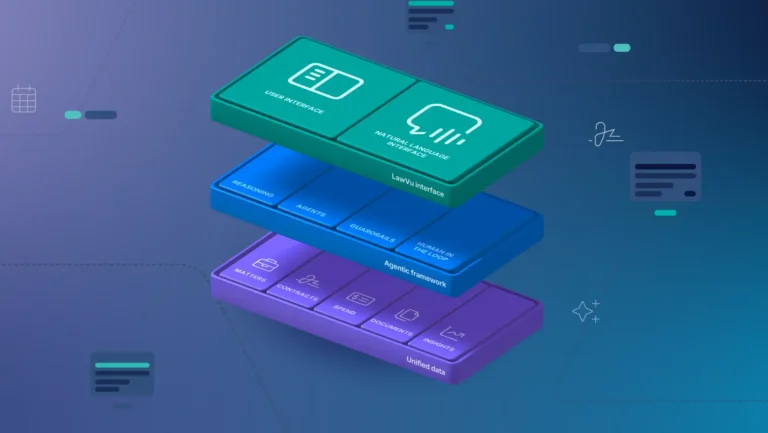
Finance, sales, and HR all have their systems, while legal has too often had a pile of disconnected point solutions. What’s been missing is an operating system, which is why we introduced LegalOS earlier this year.
A legal operating system isn’t a LawVu product. It’s a category. It holds everything you already know, the intake, the matters, and the contracts now augmented with AI agents. Think of agents as digital teammates that take action and push the work forward. What makes it work is one source of truth and one AI foundation, with governance across the whole thing.
“A legal operating system isn’t a LawVu product. It’s a category.”
Governance is the piece I think about constantly. I recently read about AI sprawl inside large US corporates, where agents get built all over the business and data becomes disconnected almost overnight. Our job is to make sure legal keeps hold of a single source of truth while the agents multiply around it.
A $96,000 morning
Here’s an example of what I’m talking about, from a recent demonstration built around a fictional distributor called Kestrel. One morning a major customer, Brightwell Hardware, says an important shipment arrived late and claims $96,000 in losses. Legal immediately has two questions: what did we promise the customer and what can we recover from the logistics provider responsible for the delay?
The request goes straight into LawVu. A workflow recognizes a contractual dispute, creates the matter, flags it as urgent, assigns the right lawyer, and brings both relevant agreements into context: Kestrel’s contract with Brightwell and the freight agreement covering the shipment. It sets initial tasks and summarizes the dispute, so the lawyer starts oriented rather than facing a blank matter.
“Our job is to make sure legal keeps hold of a single source of truth while the agents multiply around it.”
From there, LawVu Assistant works across the matter and contracts to assess Kestrel’s position, from delivery commitments and liability caps to force majeure and the rights Kestrel holds against its logistics provider, then helps draft the response. An unstructured complaint becomes a structured matter with a clear plan.
If you don’t know LawVu well, that might seem a little underwhelming. For me, that’s the exciting part, because it all happened behind the scenes. The time that saves on matter creation alone is huge. Less manual effort, with agents moving the work forward.
Better still, you don’t need developers to build these workflows. You describe the outcome in plain language, and LawVu’s agents draft the workflow for you, every step editable, triggered manually, on a schedule or by an event like that incoming email. I know that asking AI to build AI is a bit meta, but it gets you off the blank page incredibly quickly. At a recent LawVu customer advisory group session, teams built workflows from scratch and the use cases were awesome.
Seeing the whole portfolio with Lens
As good as workflows are, for me they’re just the start. AI has promised for years to make it effortless to unlock organizational knowledge, and it has often fallen short because genuine insight needs context, a deep understanding of the work that has gone before rather than documents read in isolation.
That’s why I’m so proud of LawVu Lens. Lens brings together the foundations of the LegalOS with AI to help legal teams understand the relationships, patterns, and decisions across their organization, turning disconnected data into intelligence the business can act on.
Back to our fictional distributor, Kestrel. The delivery disruption could run for another six months, so the bigger question is where else the same problem could bite. Rather than reviewing contracts one by one, I asked Lens to check where we’d agreed to tighter delivery timeframes we might struggle to meet. Lens breaks every obligation down into clear values, so instead of reading fine print you’re filtering a grid. If you want to check the AI’s reading of a clause, one click takes you to the citation in the source contract.
The shape of the risk appeared quickly. Most customers had delivery windows of around 15 business days, but three required 10 or fewer. A follow-up question on liability showed that two of those three limited us to service credits, while one allowed the customer to claim damages.
The assistant opened a matter to explore renegotiation, carrying the full conversation across to the lawyer assigned, and flagged the other contracts so their SLAs get amended at renewal.
A problem with one customer became a clear view of risk across the entire portfolio, with action already underway. I’ll admit that watching it come together was emotional. It’s a bit like watching your baby grow up. We joked that the demo area should have been called the present lounge rather than the future lounge, because Lens is here and ready to go.
“A problem with one customer became a clear view of risk across the entire portfolio, with action already underway.”
Most of you will be watching tools like Claude and ChatGPT roll out across your organizations. The question is how you connect them and let agents work with each other without losing control. That’s why we’ve also launched the LawVu MCP server, giving other AI applications in your business a secure way to connect with LawVu without losing all the value of the governance and single source of truth.
I’ve talked about the future of legal for years, but I have never felt change happening as fast as it is right now, and I’ve never been more excited to be part of it.
“I believe in-house legal is about to have more influence in the business than it has ever had.”
The teams that thrive from here will be the ones whose AI knows their contracts, their matters, and their decisions, and acts on them within guardrails legal has set. That’s what a governed operating system makes possible, and it’s why I believe in-house legal is about to have more influence in the business than it has ever had. You’re the ones who will make that happen, and we’ll be right beside you. Remember, Ryan’s future and my spare room depend on it. Welcome to the era of LegalOS.
Explore LawVu Lens and see what it can do for your team. You can also watch my full keynote, along with the other Sydney sessions, at Legal Leaders Connect Sydney.
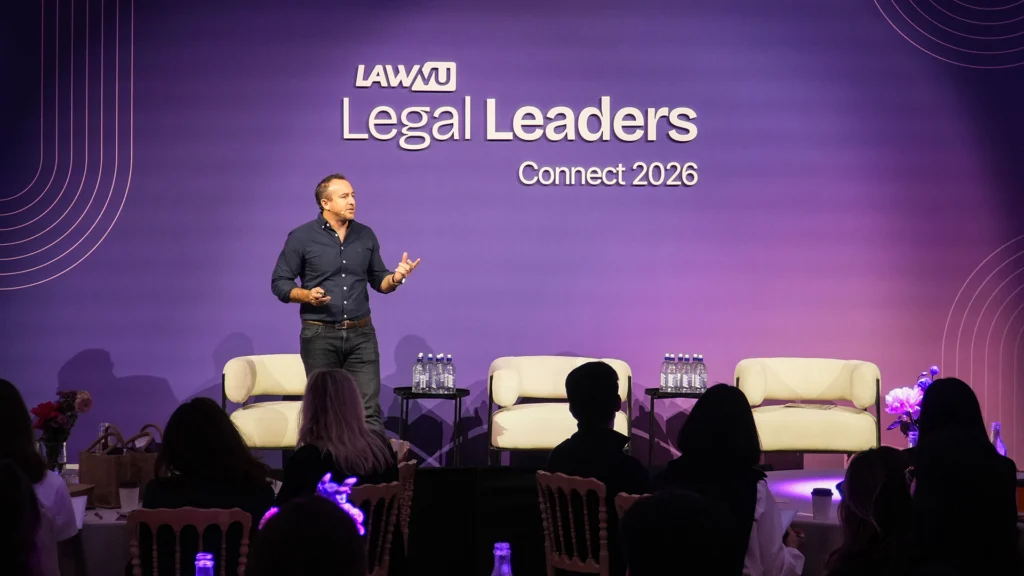
This article is adapted from Sam Kidd’s keynote presentation at Legal Leaders Connect Sydney 2026.