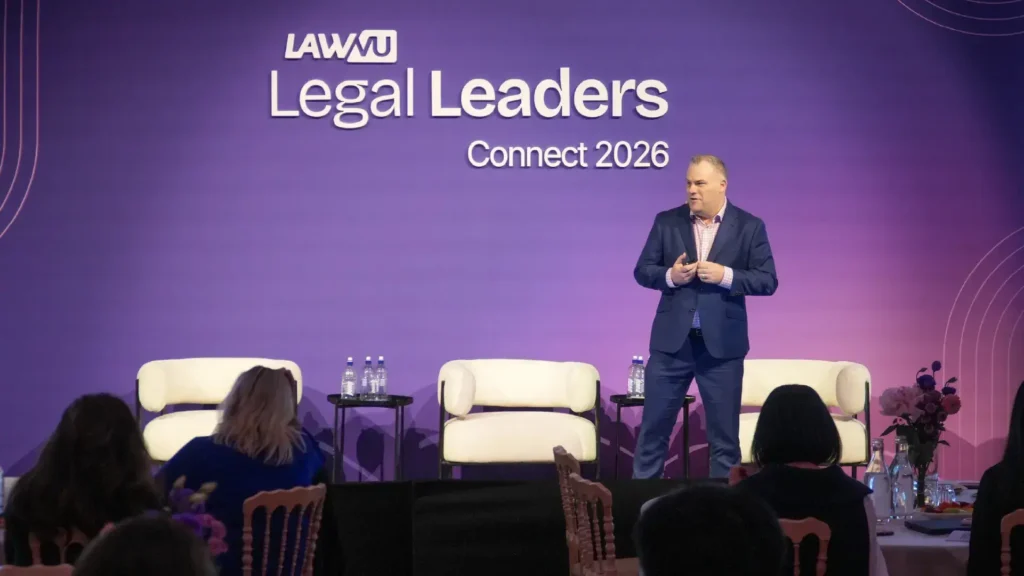
Adrian Moffatt, Executive General Manager of Legal and Corporate, has a blunt message for in-house lawyers worried about AI: stop asking what it can do, and start asking what it can’t. That single reversal, he argues, is where the future of the legal profession is being decided, and most lawyers are still asking the wrong question.
Adrian Moffatt didn’t set out to become a voice on legal leadership. But between running legal and corporate for his organization and fielding messages from in-house counsel scattered across the globe, that’s exactly what happened. One question keeps landing in his inbox more than any other, in a dozen different disguises. When AI comes for the legal work, where does the value of the legal function go?
He doesn’t answer it with a list of use cases, or a comforting statistic about which jobs are supposedly safe. Instead, he flips the question on its head. Forget what AI can do; the question that decides your career is what it can’t.
The belief legal built their careers on
There’s an unwritten belief in the legal profession, and almost every lawyer has built a career on it without ever saying it out loud: the more you know, the more you’re worth. It’s drilled in from day one of law school, rewarded in private practice, rewarded again the moment you move in-house. For a long time it worked, because legal knowledge was genuinely scarce, locked behind years of study and gated behind subscription databases nobody outside the profession could touch. When the business hit a complex legal problem, there was exactly one door to knock on, you.
That door is a lot less exclusive now. Anyone in the business can open a large language model at their desk and ask it to review a contract, summarize a statute or flag the risks in a clause, without raising a ticket, waiting three days, or booking a meeting. Whether right or wrong, the answer comes back immediately, and for a lot of what the business needs, it does the job, without legal.
The numbers behind the anxiety
The research backs up the unease. A 2023 Goldman Sachs report, The potentially large effects of artificial intelligence on economic growth, estimated how much of each profession’s workload AI would eventually absorb, and legal came in second on the list, behind only administrative roles, at an estimated 44 percent of tasks exposed. A 2026 follow-up from McKinsey, Agents, robots, and us: Skill partnerships in the age of AI, pushed that figure to 70 percent for legal work specifically. Whether the real number lands at 40, 50 or 70 percent, the direction of travel is the same.
Moffatt has already heard a sharper version of that anxiety inside his own organization: surely, we don’t need as many lawyers when we have AI. Enough other general counsel have told him the same thing that he no longer treats it as an outlier view.
Ask the other question
Most legal functions are stuck relitigating the same three conversations: which AI provider to use, what the return on investment looks like, what the business case needs to say. Reasonable questions, Moffatt says, but not the ones that matter most. Before you ask what AI can do, ask what it can’t, because that’s where your value now lives. AI is going to make information cheaper, faster and more available to anyone with a login, but information was never really the point of legal work. Moffatt stresses that businesses want decisions; someone still must make the call and that someone needs to be you.
Moffatt borrows a habit from Jeff Bezos, who has a well-worn response whenever someone asks him what’s going to change: he turns the question around and asks what won’t. Once you know what’s permanent, you can build a strategy on it. For Amazon that meant three things customers would always want: lower prices, wider choice, and faster delivery. Legal teams, Moffatt argues, need their own list of permanents, and his comes down to judgment, decisiveness, relationships and trust, none of it especially fashionable, all of it durable.
He makes the same point with a nod to Blue Ocean strategy, the idea that businesses win by finding water nobody else is swimming in, the way Cirque du Soleil traded elephants and ticket wars for premium acrobatics. Legal’s version is straightforward: drafting and document review, the busywork at the bottom of the profession, is a red ocean filling up fast with AI agents and machines, while judgment and relationships sit in the blue ocean above it.
Judgment is a skill you can teach
Moffatt defines judgment plainly: the shift from explaining what the law says to deciding what the business should do. AI is going to own more and more of the first half of that sentence, but the second half is still entirely human, and Moffatt has firm views on how to build it.
Understanding the business matters more than understanding the statute book, which for Moffatt means getting off the legal floor and occasionally picking up the phone instead of hiding behind email. Recognizing that not all risk is equal matters just as much. Private practice habits push lawyers toward eliminating every risk they find, but an in-house team that tries to do the same becomes a handbrake on the business.
He’s particularly blunt on one point: decide and recommend, don’t just advise. Nobody hands a CFO a spreadsheet and calls it strategy, and lawyers shouldn’t hand over a list of problems and call it advice either. Speed matters just as much, since perfect advice delivered three weeks after the decision has been made is worth very little. And teams need to lead with a solution instead of a caveat. Legal has a reputation as the department of no; the harder, more valuable job is being the department that finds a way to yes.
Building judgment before it is tested
Moffatt uses a technique he calls shadowing to fast track that judgment in junior lawyers. The name reflects how it works: a junior lawyer begins in a senior colleague’s shadow, following them into the meetings where real discussions happen and decisions get made, and gradually steps out of it. Before each meeting, Moffatt sits down with the junior to talk through the issue, test their thinking and help them shape a point or two they can raise when the moment comes. That preparation lets them try out a view while the stakes are still low. When the junior makes their contribution in the meeting, Moffatt acknowledges it openly as a valuable one in front of everyone at the table.
That public endorsement is where the technique does its real work. The senior people present see that Moffatt has confidence in the junior’s judgment, and their own view of the junior rises with it. His comfort passes to them. Over enough meetings, those executives start going straight to the junior lawyer instead of routing everything through Moffatt, which frees him to focus on more strategic work. It’s a deliberate transfer of trust, one meeting at a time, until the junior lawyer no longer needs someone senior nearby to be believed.
A second habit is more visual and works well in businesses built around heavy contract negotiation. Moffatt has his team plot every proposed markup on a simple risk matrix, weighing consequence against likelihood, and the results tend to surprise people: most of the redlines lawyers instinctively want to raise turn out to be in the green zone and not worth raising at all, and many of the amber ones can be solved with a phone call to sales or delivery rather than another round of drafting. What’s left, once the matrix has done its work, is a handful of genuine red flags worth fighting for and a negotiation that moves at a speed the business can live with.
The choice in front of the profession
Moffatt puts the decision back on lawyers themselves. When AI frees up capacity inside a legal function, there are two ways to spend it. Pour it back into more of the same work, done faster, and you’ll build a more efficient legal team, which is a fine outcome and, for some functions, exactly the right one. Or double down on judgment, relationships, and stakeholder management, and build something AI cannot quietly absorb to reposition your value.
Only one of those paths keeps legal at the table. The other makes it a service line measured on turnaround time. Knowledge stopped being scarce the moment everyone got an AI login. Judgment hasn’t, and nothing on the market is close to replicating it. That, Moffatt argues, is where the value of the legal function is heading, and the only question left is whether you follow it there or wait to be told the seat’s taken.
To replay Adrian’s session and others at Legal Leaders Connect, click here.