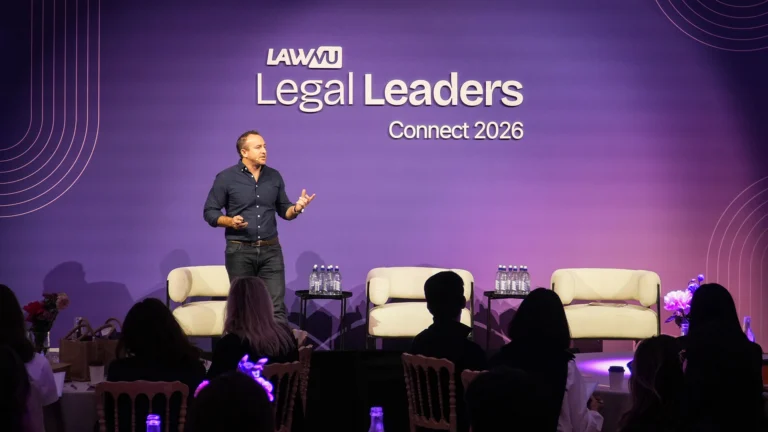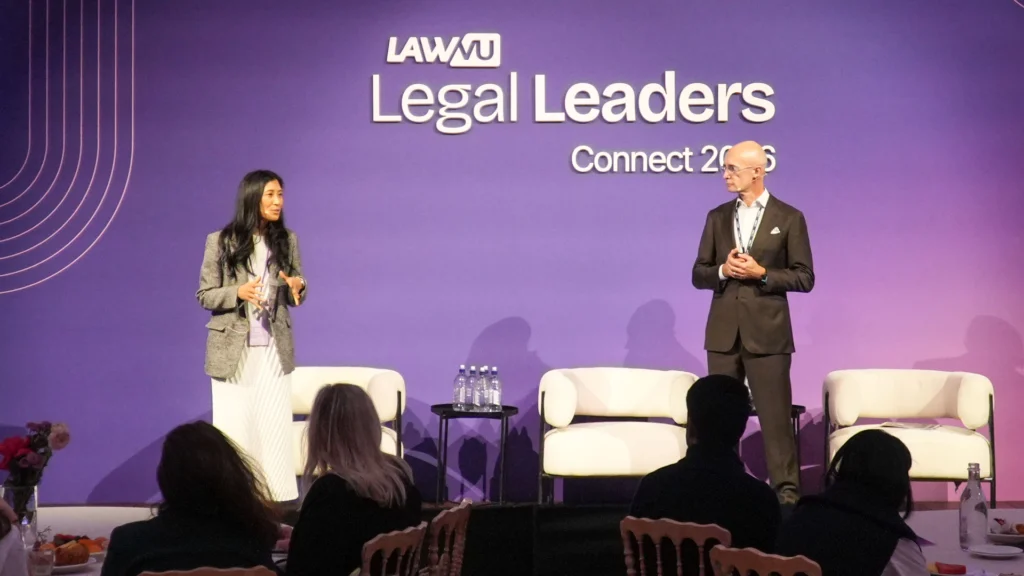
Vocus Deputy General Counsel Jillianne Osborn and LawVu Executive Vice President of Advocacy David Lancelot, explain why lasting change comes from the engine room legal builds beneath its tools.
“You didn’t go to law school so that you could answer emails,” said David Lancelot. Yet for most in-house lawyers, reactive work eats a punishing share of the week. Ask a legal team how much of its time disappears that way and the answers tend to land between 40 and 60 percent, sometimes climbing to 80, the point at which, Lancelot said, “your head explodes.” Getting it down to 10 percent is “pretty much Yoda level impossible.”
AI promises to fix that. But in their discussion, Lancelot and Jillianne Osborn made a quieter argument: transformation depends less on the tools a legal team buys than on the engine room it builds underneath them.
Lancelot blames law firm habits, where the harder you work the better you are. When working for a multinational corporate law firm, he once billed in two-minute increments. “I think of a Savile Row tailor,” he said. “Not everybody needs a beautiful suit. Some people just need a T-shirt.” Lawyers take pride in doing a task for the 50th time faster than ever, while business partners wonder, “Sorry, you did that again?” An operational mindset builds a process instead. Osborn calls the goal “working when you’re not working.”
AI raises the stakes. A veteran general counsel once told Lancelot it makes transformation both easier and harder. Prompts are easy, but without structured data, policies, and knowledge beneath them, Lancelot says the tools draw on little better than Reddit posts. “Agentic AI at scale, without investing in a structured, accurate data and process mapping, risks automating chaos.”
Building the engine room
Osborn doesn’t pretend Vocus has it all solved. Although her 15-person team supports one of Australia’s largest fiber networks, plus data centers and subsea cables, she said: “My team faces the same challenges as most teams – finding time to transform the legal function, whilst running and growing the business.” The difference lies in how they chose to respond.
Osborn has built her legal function around four priorities: faster contracting, less friction, more self-service, and growth without adding lawyers. Network teams facing land access rejections send template responses without calling legal, and sales teams download pre-approved contracts for common customer asks. Osborn once worried self-service pushed work onto colleagues. Then she thought about supermarket self-checkouts, which most of us choose because they are quicker, even though we weigh and pack everything ourselves.
Winning support means speaking the business’s language. Osborn talked about a Vocus leadership offsite and sales kick-off that took the FIFA World Cup as its theme. She drew what could be termed the short straw, the 4pm slot, which was the last session after a full day of strategy. Her brief was to show how legal helps the business grow and the sales team win, so with a visibly tired audience in front of her, she ran with the football theme. Sales became the strikers and legal the defensive midfielders, seeing the whole pitch and moving the ball quickly so others could score. “We don’t often get the glory for the deals that we win. But everyone knows when we’re missing,” she said.
Standard terms became hot-pink football boots, built for Vocus’s style of play. Negotiation fallbacks became set pieces, so a customer wanting longer than 30-day payment terms gets a credit-approved answer in a contract that sales can pull any time.
That groundwork widens the base of her pyramid, the work legal won’t do, such as non-negotiable SaaS terms, low-value procurement, NDAs and the buffet agreement, Lancelot’s nemesis at eBay, where he spent hours renumbering statements of work. Vocus already allocates matters automatically in LawVu and is moving to triage work by risk and contract value.
Lancelot suggests starting with policy, like a marketing checklist. “Does it involve a celebrity? No. Have we been sued about this before? No.” If it isn’t a billboard campaign or a big spend, go for it. He calls this the disaggregation of work. “You don’t have your CMO writing ad campaigns in your leadership team meeting,” he said, yet CLOs are routinely thought of as real time legal advice dispensers as opposed to the architects of business accelerating systems, like their peers on the leadership team.
Making time on purpose
The building, it turns out, is the easy part. After Osborn’s first sprint, one of her lawyers told her, “I can’t believe how easy it was to create this agent.” Finding the time is harder, and Osborn admits she has said “I don’t have the time” herself. Goals and KPIs help, but this work “doesn’t shout very loud” next to a salesperson’s demands.
So Vocus builds it into the week. A learning moment on AI or legal operations is passed around every team meeting, and failed attempts are celebrated alongside wins. Protected time has moved from Fridays to Mondays, leaving a buffer if Monday is hijacked. Some lawyers ask their leaders to book the time and hold them to account.
All that protected time is an investment in knowledge management, which Lancelot points out was long dismissed as back office and is now where the leverage sits. “With the technology that we have today, the scale comes from the accurate, curated and relevant knowledge.” Osborn sees the same engine room from the inside. Build it well and the work gets easier, until it gets done “when you’re eating, sleeping, and playing.”
To watch the session replay in full, click here.